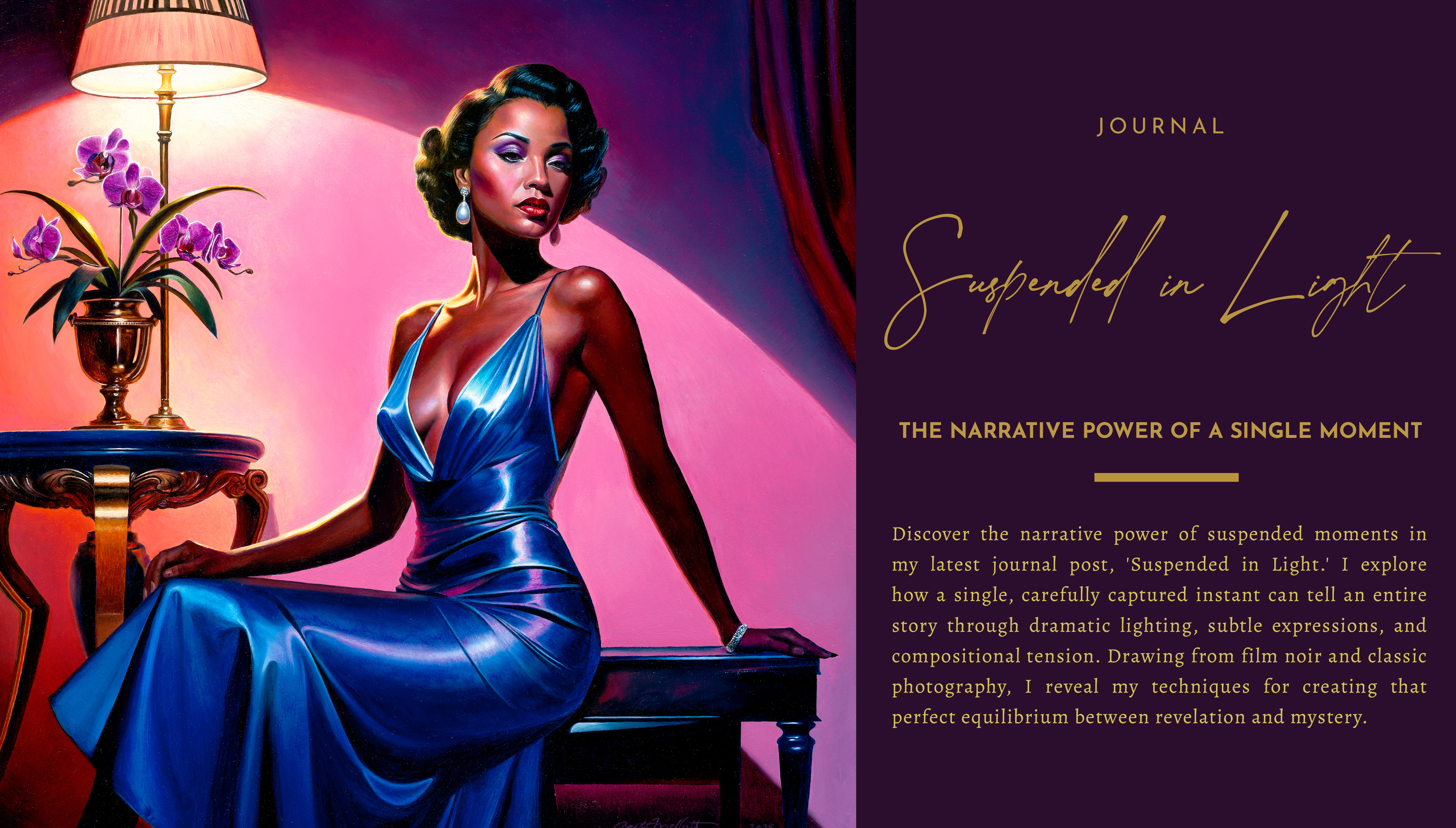
In my paintings, I’ve always been drawn to that pivotal moment – the breath held, the glance about to be returned, the decision not yet made. These suspended instants contain a universe of possibilities, capturing not just what is, but what might be.
Classical painting has always sought to freeze time, but the tradition of noir cinema taught us that certain frozen moments can feel paradoxically alive with movement and tension. When a femme fatale pauses in a doorway, bathed in dramatic light, the stillness pulses with narrative energy. This is the quality I seek to capture in my work – not static portraiture, but moments pregnant with a story.
The Psychological Weight of the Pause

The most compelling stories often live in the spaces between actions. In my painting “Renaissance Woman,” I deliberately chose to capture my subject in a moment of contemplation rather than overt action. Her slightly downcast gaze and the careful positioning of her hands create what filmmakers call “anticipatory tension” – the feeling that something significant is about to happen.
This technique draws directly from directors like Alfred Hitchcock, who understood that suggestion is more powerful than explicit revelation. The audience (or, in my case, the viewer) becomes an active participant, constructing the before-and-after of the scene. This psychological engagement creates a deeper, more personal connection to the work.

Technical Approaches to Suspended Time

Creating this sense of suspended animation requires specific technical approaches. I pay particular attention to:
- The quality of light – Sharp contrasts between light and shadow suggest a flash of illumination in darkness, a momentary revelation
- Micro-expressions – Subtle details in the face that hint at complex interior states
- Body language – Positions that suggest both stasis and potential movement
- Environmental elements – Objects and settings that provide narrative context
Cinematic Influences
My approach to these suspended moments draws heavily from cinematographers like John Alton, who pioneered noir lighting techniques that transformed ordinary scenes into moments of extraordinary tension. His work on films like “The Big Combo” demonstrated how a single, dramatically lit frame could tell an entire story.


I’m equally influenced by still photographers who capture decisive moments in fashion and portraiture—particularly George Hurrell, whose portrait of Jane Russell for “The Outlaw” created an entire narrative from a woman simply reclining on hay, and Horst P. Horst, whose fashion images suggested complex interior worlds beneath glamorous surfaces.


Between Revelation and Suggestion
The most compelling aspect of a suspended moment is the balance between what is revealed and what remains hidden. Too much explicit detail, and the narrative closes; too little, and the viewer cannot enter the world. I aim for that perfect equilibrium where the painting offers enough concrete detail to establish a distinct reality while leaving space for the viewer’s imagination.
In my recent work, I’ve been exploring how fabric and shadow can function as both revelation and concealment – the satin dress that both defines and obscures the form, the dramatic lighting that simultaneously illuminates and creates deeper shadows.

These suspended moments fascinate me because they mirror life’s most significant experiences. Our memories rarely crystallise around extended sequences but instead around singular, charged instants – the glance that began a love affair, the hesitation before a life-changing decision, the silent pause that said everything words could not.
Through my paintings, I hope to create similarly meaningful moments for viewers—instances of beauty and tension that invite you to pause, wonder, and imagine the stories that might unfold from this single, suspended point in time.
In the next post I’ll explore why beauty and glamour remain powerful cultural forces in our contemporary world, despite – or perhaps because of – our increasingly casual and transparent age.
